


Page 19 - rcf126_Neat
P. 19
19


         Totally differentiating (1), we get,                 rios conceitos tomados de empréstimo à Física, nomeadamente os concei-
                                                              tos  de  Momento,  Massa,  Velocidade,  Impulso,  Força,  Aceleração,  entre
                                                              outros.  Assim,  importa  recordar  estes  conceitos,  tal  como  são  definidos
                                                              naquela ciência exacta, para melhor se compreender a sua aplicação por
         Here dC (increment of equity capital) means P, so that,   Ijiri na Contabilidade.

             dC = P = R – E                                                                       (2’)   O Momento (“Momentum”) de um objecto é o produto da sua Massa pela
                                                              sua Velocidade, ou seja,
         Equations (1’) and (2’), respectively, are only conversions of equations (1)
         and (2) in terms of differentiation. However, it should be noted that the for-
         mer equations are of different order from the later. Especially, it should be   Um objecto pode ter um grande Momento devido à sua grande Massa ou
         emphasized that by their nature the terms, R, E and P (flow variables) are in   devido à sua grande Velocidade. O Momento é uma grandeza vectorial (um
         a different order than A, L and C (stock variables). This is fundamental to   Vector). Tem direcção e sentido. Convém estar atento aos sinais dos com-
         the  understanding  of  the  transformation  of  accounting  variables  into  vari-  ponentes do Momento.
         ables of a time-varying nature.
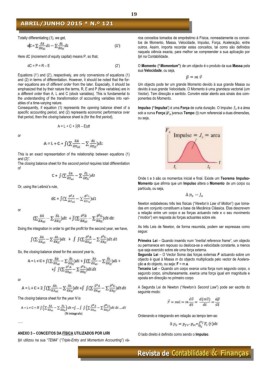
         Consequently,  if  equation  (1)  represents  the  opening  balance  sheet  of  a   Impulso (“Impulse”) é uma Força de curta duração. O Impulso      é a área
         specific accounting period, and (2) represents economic performance over   sob a curva Força       versus Tempo (t) num referencial a duas dimensões,
         that period, then the closing balance sheet is (for the first period),   ou seja,

                           A = L + C + ∫(R – E)dt

         or


         This is an exact representation of  the relationship between  equations  (1)
         and (2)”.
         The closing balance sheet for the second period requires total differentiation
         of

                                                              Onde ti e tf são os momentos inicial e final. Existe um Teorema  Impulso-
                                                              Momento que afirma que um Impulso altera o Momento  de um corpo ou
         Or, using the Leibniz’s rule,                        partícula, ou seja,


                                                              Newton estabeleceu três leis físicas (“Newton’s Law of Motion”) que toma-
         or                                                   das em conjunto constituem a base da Mecânica Clássica. Elas descrevem
                                                              a relação entre um corpo e as forças actuando nele e o seu movimento
                                                              (“motion”) em resposta às forças actuantes sobre ele.

         Doing the integration in order to get the profit for the second year, we have,   As três Leis de Newton, de forma resumida, podem ser expressas como
                                                              segue:

                                                              Primeira Lei – Quando inserido num “inertial reference frame”, um objecto
                                                              ou permanece em repouso ou desloca-se a velocidade constante, a menos
         So, the closing balance sheet for the second year is,   que seja exercido sobre ele uma força externa.
                                                              Segunda  Lei – O Vector Soma das forças externas F  actuando sobre um
                                                              objecto é igual à Massa m do objecto multiplicada pelo vector de Acelera-
                                                              ção a do objecto, ou seja: F = m.a.
                                                              Terceira Lei – Quando um corpo exerce uma força num segundo corpo, o
                                                              segundo corpo, simultaneamente, exerce uma força igual em magnitude e
         or                                                   oposta em direcção no primeiro corpo

                                                              A Segunda Lei de Newton (“Newton’s Second Law”) pode ser escrita do
                                                              seguinte modo:
         The closing balance sheet for the year N is


                                                              Ordenando e integrando em relação ao tempo tem-se:
         …..


         ANEXO 3 – CONCEITOS DA FÍSICA UTILIZADOS POR IJIRI   O lado direito é definido como sendo o Impulso.
         Ijiri utilizou na sua “TEMA” (“Triple-Entry and Momentum Accounting”) vá-

