


Page 20 - rcf126_Neat
P. 20
20


                    Impulso =                                                        TABLE 1
                                                                           The Conventional and Proposed Measurement Systems
                = Área sob a curva                                  Conventional Measurement    Proposed Measurement
                                                                    [Wealth W and Income ∆W]      [Momentum Ẇ and Impulse ∆Ẇ]
         O Impulso em Física tem como unidade de medida o Newton, N, que se   (Balance Sheet)     (Balance Sheet)
         expressa por Kg m/s.                                      Wealth Statement as of 1/1/87      Momentum Statement as of 1/1/87
                                                              Cash                 $150     Sales           $125/mo
         Importa ter presente na Física as denominadas “Conservation  Laws”. As   Receivables   300     Cost od Sales   -85/mo
         interacções  podem  provocar  alterações  nos  objectos/partículas  (“things”).
         Todavia, alguns objectos/partículas (“things”) não são alterados pelas inte-  Inventories   450     Operating Expenses   -10/mo
         racções. Diz-se, então, que eles são conservados (“conserved”). As partícu-  Fixed Assets   900     Depreciation   -5/mo
         las de um sistema isolado (“isolated system”) interagem entre si – prova-  TOTAL ASSETS   $1,800     Interest Expenses   -5/mo
         velmente de forma intensa -, mas não com o ambiente externo. A Massa, o   Payables   -400     Income Taxes   -8/mo
         Momento e a Energia de um sistema isolado são conservados. As Leis da
         Conservação (“Conservation Laws”) constituem a base para a solução de   Loans   -500      NET MOMENTA   $12/mo
         um novo e poderoso problema estratégico, designadamente,   OWNERS’ EQUITY   900
                                                              Less: Owners’ Net Contribution   600
               Valor Final (“Final Value”) = Valor Inicial (“Inicial Value”)    NET WEALTH   $300

                                                                      (Change Sheet)
                                                                                                  (Change Sheet)
         A  conservação  do  momento  (“conservation  fo  momentum”)  num  sistema   Income Statement for 1987      Impulse Statement for 1987
         isolado é uma consequência da Terceira Lei de Newton (“Newton’s Third
         Law”)                                                Sales               $1.800     New Product Introduction (4/1/87)   $5/mo
                                                              Cost of Sales       -1.200     Its Tax Effect                     (4/1/87)   -2/mo
                                                              Operating Expenses   -180     New Product Introduction (7/1/87)   10/mo
         ANEXO 4 – UM EXEMPLO DE APLICAÇÃO DA “MOMENTUM ACCOUN-  Depreciation      -60     Operating Staff Addition    (7/1/87)   -10/mo
         TING” À GESTÃO POR OBJECTIVOS COM BASE EM IMPULSOS   Interest Expenses    -60     Mfg Cost Cutting              (10/1/87)    5/mo

                   Ninguém melhor que Ijiri pode explicar a sua “Momentum Accounting”   Income taxes   -120     Its Tax Effect                    (10/1/87)   -2/mo
         aplicada  à  Gestão  por  Objectivos  numa  empresa,  inclusivamente  com  o   NET INCOME   $180     NET IMPULSES   $6/mo
         recurso a uma ilustração. Yuji Ijiri, no artigo intitulado “Momentum Accoun-  (Change Sheet)      (Change Sheet)
         ting and Managerial Goals on Impulses”, publicado na Management Scien-  Wealth Statement as of 12/31/87   Momentum Statement as of 12/31/87
         ce, Feb 1988, Vol 34, Issue 2, pp 160-66, escreveu (sem tradução):   Cash   $200     Sales         $175/mo
                                                              Receivables          360     Cost of Sales     -115/mo

         …………………….“                                           Inventories          600     Operating Expenses   -20/mo
                                                              Fixed Assets         840     Depreciation       -5/mo
                         1. Momentum Accounting                  TOTAL ASSETS     $2.000     Interest Expenses   -5/mo
                                                              Payables             -420     Income Taxes     -12/mo
         Conventional  accounting measures  "wealth," positive (assets) or negative
         (liabilities). It measures wealth not in isolation as in single-entry bookkee-  Loans   -500     NET MOMENTA   $18/mo
         ping but in relation to "income' so  that every change in net wealth is explai-  OWNERS’ EQUITY   $1.080
         ned or accounted for by revenue or expense items that are considered to be   Less: Owners’ Net Contribution   600
         responsible for the change. In this way, wealth W and income ∆W are linked   NET WEALTH   $480
         together under a double-entry framework.
         Momentum accounting measures various income momenta, or "momenta"
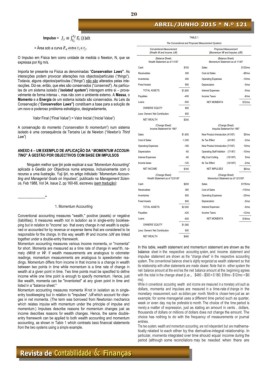
         for short. Momenta are measured as a time rate of change in wea1th, na-  In this table, wealth statement and momentum statement are shown as the
         mely  dW/dt  or  Ẇ.  If  wealth  measurements  are  analogous  to  odometer   balance  sheet in the  respective  accounting system, and  income  statement  and
         readings,  momentum  measurements  are  analogous  to  speedometer  rea-  impulse  statement are shown as the “change sheet” in the  respective  accounting
         dings. Momentum differs from income in that income is a change in wealth   system. The conventional balance sheet is slightly reorganized as wealth statement so that
         between two points in time  while momentum is a time  rate of change  in   its relationship with other statements are made clearer. Note that in  either system the
         wealth at a given point in time. Two time points must be specified to define   net balance amount at the end les the net balance amount at the beginning agrees
         income while one time point is enough to specify momentum. Hence, just   with the total in the change sheet (i.e.,  $480 - $300 = $ 180; $18/mo - $12/mo = $6/
         like wealth, momenta can be "inventoried" at any given point in time and   mo).
         listed in a "balance sheet."                         WhiIe in conventional ,accounting  wealth  and income are measured in a monetary unit such as
         Momentum accounting measures momenta Ẇ not in isolation as in single-  dollars,  momenta  and impulses are  measured in a  time-rate of change in  the
         entry bookkeeping but in relation to "impulses" ∆Ẇ which account for chan-  monetary measurement, such as dollars per month. Month is chosen here just as an
         ges in net momenta. (The term was borrowed from Newtonian mechanics   example; for some managerial uses a different time period such as quarter,
         which  relates  impulse with  momentum  under  the  principle  of  impulse  and   week or even day may be preferable to month. The choice of the time period is
         momentum.)  Impulses  describe  reasons  for  momentum  changes  just  as   merely a matter of expression, just as stating an amount in cents , dollars,
         income  describes  reasons  for wealth  changes.  Hence,  the  same  double-  thousands of dollars or millions of dollars does not change the amount. The
         entry framework can be applied to both wealth accounting and momentum   choice has nothing to do  with the frequency of measurements or journal
         accounting, as shown in Table 1 which contrasts basic financial statements   entries.
         from the two systems using a simple example.         The two system, wealth and momentum accounting, are not independent but are mathema-
                                                              tically related to each other by the derivative-integral relationship. In
                                                              particular, momenta integrated over time should equal income during the
                                                              period  (although  some  reconciliations may  be  needed  when  there  are

